.png)
Why Veterans Have the Edge in AI-Resistant Cloud Careers
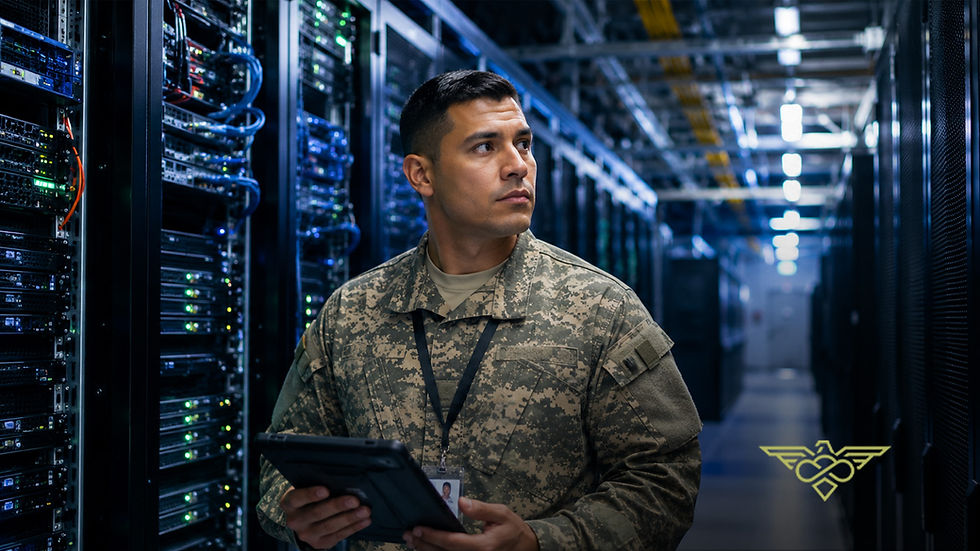
Every week we see another headline about AI replacing jobs. White-collar coding, content work, customer support, all of it being automated, restructured, or quietly thinned out. We hear from veterans in our community who read that noise and start to wonder if the door to tech is closing right as they reach for it.
It is not. And we want to walk you through why.
A new wave of research and hiring data from early 2026 shows the opposite of what the headlines suggest. The AI boom is not flattening tech careers, it is shifting them, and the shift lands squarely in the territory where you, as a veteran, already have the strongest hand: the physical and operational backbone of the cloud. That is our whole mission at Cloud Veterans, and the data has caught up to what we have been telling our community for years.
The data behind the shift
In February 2026, Hire Heroes USA and Redeployable released "The AI Career Shift: Where Veterans Should Focus in 2026," a joint report combining two years of veteran retention data with Bureau of Labor Statistics projections and AI automation models. The headline finding, as Charlotte Creech, Chief Program Officer at Hire Heroes USA, put it, was that veterans are already extremely well positioned to transition into roles that have low likelihood for disruption due to AI.
Three things drove that conclusion. Veterans show higher retention and faster advancement when roles match their strengths. BLS projections point to real, durable demand in cybersecurity, healthcare, infrastructure builds, and supply chain. And the jobs in those sectors resist full automation because they need human judgment, physical presence, and coordination under pressure, the exact mix the military trains into people.
The hiring side of the picture matches. The U.S. data center industry is on track to hit 650,000 permanent positions by 2026, a 30 percent jump from 2023, with roughly 340,000 of those roles currently unfilled. AI workloads are driving more than $300 billion in infrastructure expansion from hyperscalers alone, and the Uptime Institute reports that 58 percent of data center operators cannot find qualified staff.
We will say the quiet part out loud. The bottleneck for AI is no longer just chips or models, it is people who can keep the lights on, the cooling running, and the racks online. That is you.
Why the AI build-out favors our community
A working AI data center is a mission critical environment. It runs 24/7, it cannot tolerate sloppy procedure, it depends on shift handoffs, checklists, alarm response, and calm troubleshooting at 3 a.m. when something is melting. Read that sentence again. We just described every duty section you ever stood.
Hiring managers at hyperscalers tell us the same thing on repeat: veterans show up on time, finish the checklist, and do not panic when the alarm goes off. That is not soft praise, that is the difference between a green status board and a multi-million-dollar outage.
Specific military backgrounds map almost one-to-one onto facility and cloud operations roles:
Army 25B (IT Specialist), 12P (Prime Power), 12R (Interior Electrician), 91D (Power Generation), and 94F (Electronic Devices Repairer) line up with critical environment and facilities engineering work.
Air Force 3E0X1 (Electrical), 3E1X1 (HVAC), 3D1X2 (Cyber Transport), and 2A6X6 (Electrical/Environmental) map directly into facility and network technician roles.
Navy ETs, ITs, and CTNs cover server maintenance, networking, and security operations.
If you spent your service maintaining complex systems, you already speak the language. The certifications and tooling are the gap, not the mindset, and that gap is the one we exist to help you close.
Where the salary ranges actually land
The pay reflects the talent shortage. Entry-level data center technicians start in the $70,000 to $95,000 range, with clear progression into the $140,000 to $180,000 band at senior levels. Data center engineering roles span $84,000 to $196,000, and senior infrastructure or power electronics specialists can reach $240,000 or more as hyperscalers bid against each other for scarce talent.
Cloud engineering on the software side tracks similarly. Veterans entering cloud engineer roles report $90,000 to $170,000 depending on clearance status and experience, with a 10 to 20 percent premium on cleared roles.
The clearance angle is worth pausing on, because we get questions about it every week. A TS/SCI clearance costs an employer $5,000 to $15,000 and takes 6 to 12 months to process from scratch. If you walk in already holding one, you skip that line entirely, and federal contractors and GovCloud shops will prioritize you for that reason alone. If you do not have a clearance, the commercial sector at companies like Equinix, Digital Realty, QTS, and the commercial arms of AWS, Microsoft, and Google still hires on skills.
The pipelines are already built
The hardest part of breaking into tech used to be finding the on-ramp. In 2026, the on-ramps are everywhere, and most of them are free. These are the ones we point our community to most often:
Microsoft Military Datacenter Pathway (MDP). An 11-week virtual program built specifically for transitioning service members, with paid training and direct pathways into Critical Environment Technician, Datacenter Technician, and Datacenter Inventory and Asset Technician roles. Upcoming application deadlines include June 11, 2026 for the 26-3 cohort and October 8, 2026 for the 27-1 cohort. No prior IT experience required. Apply through Hiring Our Heroes.
Microsoft Software and Systems Academy (MSSA). More than 4,000 graduates over 13 years, with current learning paths in Cloud Application Development, Server and Cloud Administration, and Cybersecurity Operations.
Oracle data center hiring. Oracle is hiring data center technicians across its expanding U.S. footprint, including new sites tied to the $500 billion Stargate program (Oracle, SoftBank, OpenAI, MGX) aimed at building out AI infrastructure.
SkillBridge. Eligible within 180 days of separation. Microsoft, AWS, Google, Equinix, Digital Realty, and Texas Instruments all run SkillBridge cohorts tied to data center and cloud roles. Texas Instruments is currently posting Jr. Cloud Engineer SkillBridge slots in Dallas.
VET TEC 2.0. The VA is relaunching Veteran Employment Through Technology Education Courses, with applications expected to open as early as June 2026. Approved training providers will cover software development, cloud engineering, and cybersecurity tracks. The VA pays training providers directly, and participants may receive a monthly housing allowance.
What we recommend in the next 90 days
If this lines up with where you want to point your career, the moves are concrete and short. Here is how we coach our community through it.
First, pick a target track. Data center operations if your background is electrical, mechanical, HVAC, or power. Cloud engineering or cybersecurity if your background is signal, IT, or cyber. The two tracks pay similarly and both are AI-resistant for the same underlying reasons.
Second, pick one certification and start. CompTIA Security+ and AWS Cloud Practitioner are the most universally recognized entry points and both can be earned in under 90 days of focused study. For data center work, the CDCP (Certified Data Center Professional) is the industry standard starter.
Third, apply to a pipeline program before you apply to jobs. MDP, MSSA, SkillBridge, and VET TEC 2.0 exist specifically because the companies on the other side need exactly the people they produce. A cohort placement is worth more than 50 cold applications, every time.
Fourth, translate your service into the language hiring managers actually use. Not "managed personnel," but "led 24/7 shift operations across three watch sections." Not "performed maintenance," but "executed preventive maintenance on critical infrastructure with zero downtime over an 18-month deployment." Hyperscaler hiring managers know what those words mean, and we help our members rewrite their resumes in exactly that voice.
The bottom line
AI is reshaping the workforce, that part is true. What the 2026 data shows, and what we see every day inside our community, is that the reshaping is creating massive new demand for the exact kind of disciplined, procedural, high-stakes operational work that veterans already do better than almost anyone.
The cloud has to live somewhere. Someone has to build it, run it, protect it, and respond when it breaks at 3 a.m. That is not a job AI is taking. That is a job AI is creating, by the hundreds of thousands, and the industry is openly telling veterans that the door is held open.
If you served, the question is not whether there is a place for you in cloud and AI infrastructure. The question is which on-ramp you take first, and we are here to help you pick it.


Comments